
Deed Types Recorded in Missaukee
Every real-estate instrument in the county passes through the Missaukee County Clerk and Register of Deeds. The office records, indexes, and maintains the transactions. Each recorded document carries the parties, the conveyance wording, execution and recording dates, the legal description, exceptions, and prior references. Those details are what test a chain. The deed type matters too, because each instrument makes different promises about the land.
| Deed Type | What It Does | Common Use |
|---|---|---|
| Warranty deed | Conveys the stated interest with title promises | Ordinary arms-length transfers |
| Quitclaim deed | Conveys whatever interest the grantor holds | Family, trust, or corrective transfers |
| Personal representative deed | Conveys through an authorized estate representative | Probate and estate administration |
| Trustee deed | Conveys property held under a trust | Trust administration |
| Tax deed | Documents a transfer after the statutory tax process | Tax-foreclosed property |
Not everything recorded beside a deed is a deed. A mortgage secures debt. A release clears a recorded claim. An easement grants someone a defined use of the land without conveying it. Read the label on the instrument itself, and remember that an index entry is only a pointer to the full legal text.
Missaukee Register at Canal Street
The Register of Deeds sits at 111 S. Canal Street, PO Box 800, Lake City, MI 49651. Hours are Monday through Friday, 8:30 AM to 5:00 PM except county holidays. Call 231-839-4967 or email clerk@missaukee.org ahead of a long historic search. Staff can confirm the right index, the copy route, and the payment method.
Recorded material spans deeds, mortgages, land contracts, assignments, releases, easements, restrictions, and plats. Bring party names plus land clues. Add a year range, parcel number, lot and block, or a section-township-range description. An older book/page reference also helps. These details keep two people who share a name from merging into one chain.
The Register's official page lists the office and its contact details. It also covers the real-estate recording function (Missaukee County Clerk and Register of Deeds).
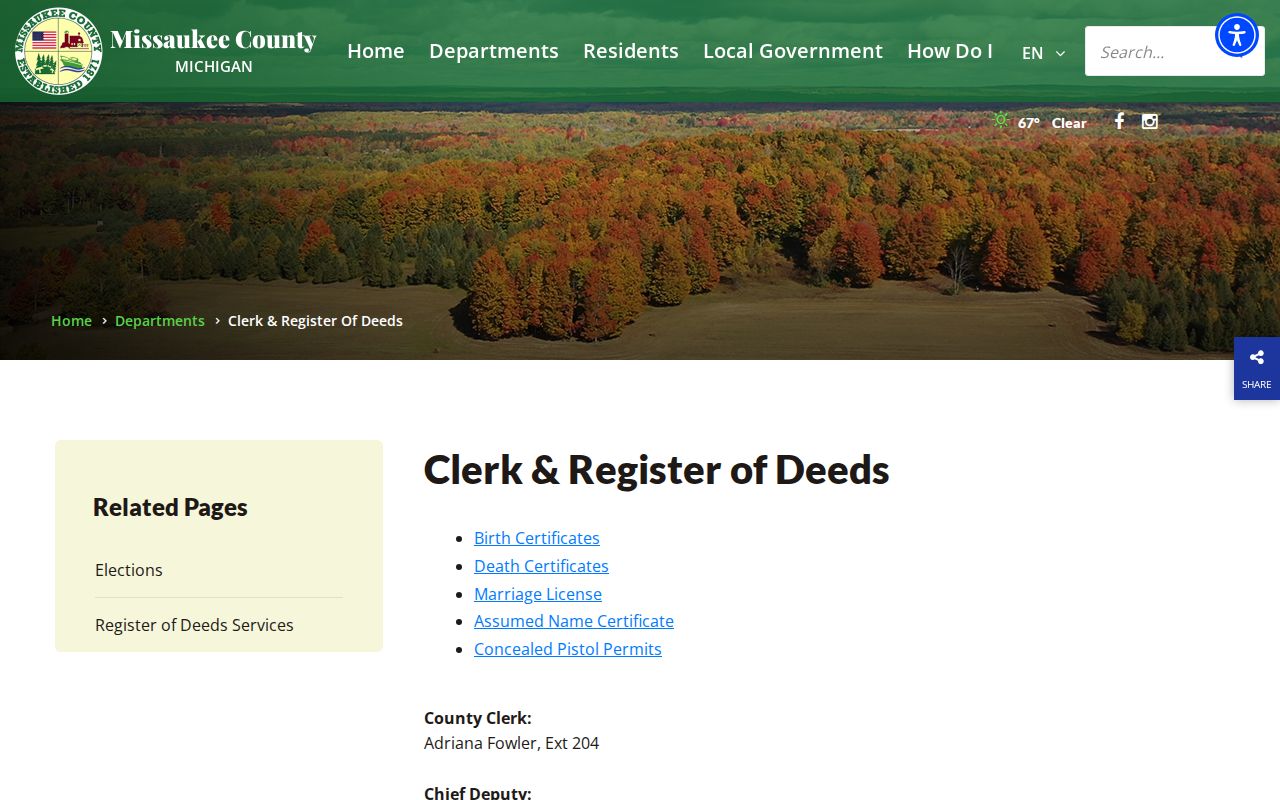
That office remains the authoritative fallback because no public online grantor-grantee cutoff was verified.
Missaukee Deed Search Fields
Missaukee County publishes no searchable web index for deeds and no live result schema. Guessing at a cutoff year, an image fee, or an index field would mislead. Instead, build the request around what a deed-book search truly needs.
| Party role | Grantor or grantee, searched separately |
|---|---|
| Name variants | Initials, married names, entities, trusts, and representatives |
| Time range | Recording years covered by the request |
| Land identity | Parcel number and full legal-description clues |
| Record reference | Book/page or instrument number when known |
| Instrument type | Deed, mortgage, release, easement, restriction, or plat |
Execution date and recording date are different facts. Compare both, and when a description covers only part of a tract, read every prior instrument it references.
Read Missaukee Grantor-Grantee Entries
Start the backward chain with the current deed. Find today's owner as grantee, note the grantor on that acquisition, then hunt that grantor as a grantee in the earlier transfer. Match the same parcel at every step. Names alone can weld unrelated chains together.
- Locate the newest deed and confirm its grantee, description, and recording reference.
- Record the grantor, then search that name as grantee for the same land.
- Compare acreage, lot and block, section terms, exceptions, and prior references.
- Repeat through the county index; request deed books or older media when web access ends.
- Grantor
- The party conveying an interest.
- Grantee
- The party receiving that interest.
- Chain of title
- The linked sequence of conveyances for the same land.
- Book/page
- A volume and page reference used to retrieve a recorded document.
E-Recording Began in 2023
Missaukee County launched e-recording on June 12, 2023. The Register services page names CSC eRecording and Simplifile as accepted vendors. Documents move through the system during weekday office hours. Vendor charges may appear alongside county statutory fees.
One limit stands out. Warranty and quitclaim deeds are not accepted through county e-recording. Missaukee still records those deed types; the electronic channel simply excludes them. Confirm the counter or alternate procedure before submitting.
The official e-recording notice on the Register services page shows the start date, vendors, hours, and exclusions (Missaukee Register of Deeds services).
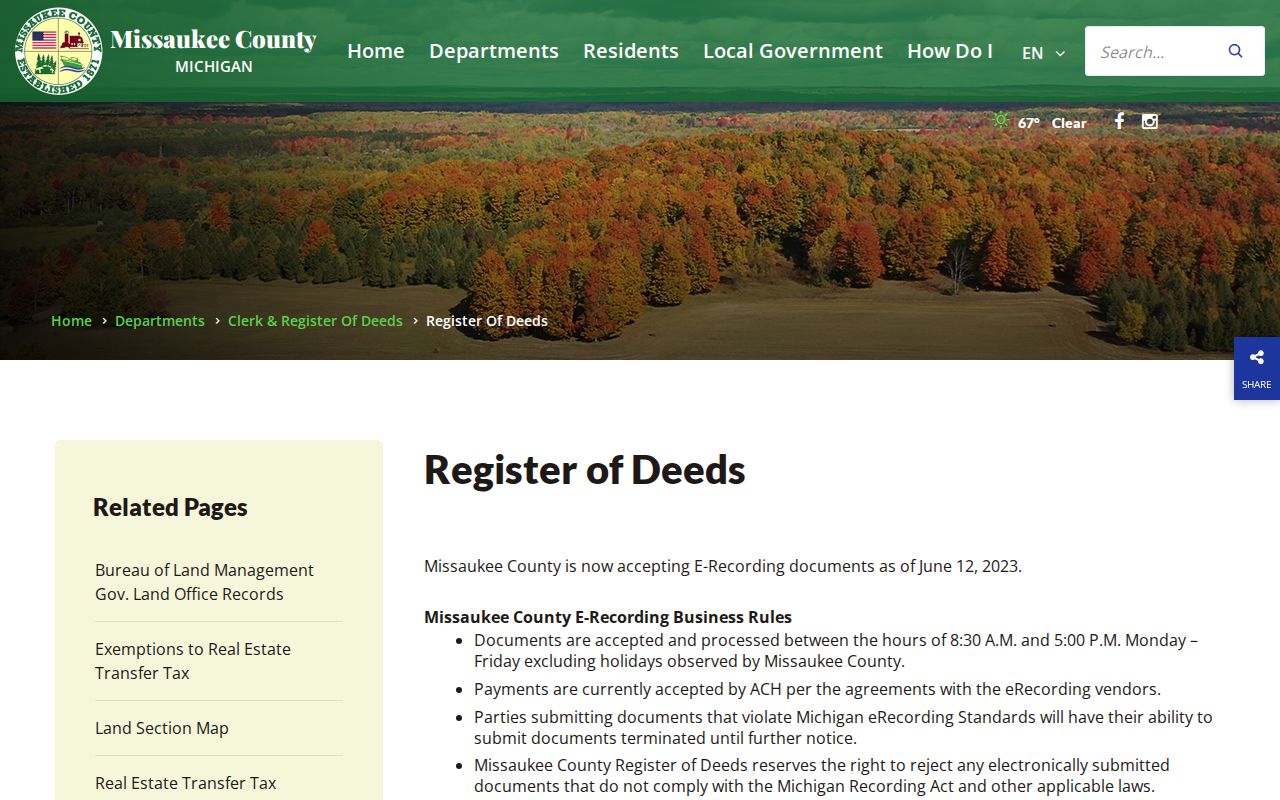
That rule governs submission only. E-recording is not an online deed-search service.
Note: E-recording access may end for a submitter who violates Michigan standards or the Recording Act.
Request a Missaukee Deed Lookup
The clearest published written route is the county lookup form. Public Act 698 of 2002 authorizes the land-record search fee. Missaukee charges $0.50 per year searched with a $5 minimum. The form requests a name or company plus search information.
Know what a lookup delivers. It is not certified, not a document search, and not a full title search. Confirm current form submission and payment with the Register. For a specific deed, give the party names, an approximate recording date, the legal description, and any book/page or instrument reference. Ask separately about plain and certified copies, since the county publishes no complete copy-fee schedule.
Extend Missaukee Deeds Into Archives
Missaukee County was organized in 1871, so older land identity can wander beyond local deed books. An early parcel may surface in federal patents, predecessor-county material, township records, or later county deed records. The Register page links the federal Bureau of Land Management GLO records, useful for tracing an original patent or survey description. Private transfers after a patent still belong in the county chain.
Printed sources add depth. The Library of Michigan county guide lists the Standard Atlas of Missaukee County from 1906, a 1941 county map, possible 1930 plat material, land atlases covering 1981-1997, Farm & Home plat books from 2007-2009, and a 1906 plat-map index. Archives of Michigan finding aids identify tax rolls for 1861-1868 as RG 71-161 and for 1871-1955 as RG 76-77. A tax roll can back an occupancy or assessment clue. It never replaces a deed.
Old place names matter in Missaukee too. McBain records may say Owens, the name of the 1888 railroad station and post office before the 1889 rename. Lake Township sources may say Mitchell or Jennings, which is not the incorporated City of Lake City. Search both old and modern terms while holding the legal description constant.
Handle Branching Missaukee Chains
A clean Missaukee chain can break quietly. The trouble starts when a deed conveys part of a parcel, combines tracts, corrects an earlier description, transfers land through probate, or places property in a trust. Follow the parent tract and the split-off side whenever the acreage or description changes. A correction deed may simply reword the description. It does not create a new sale.
Mortgages, assignments, releases, and liens matter for encumbrance research, yet none of them automatically conveys the fee interest. A trustee or personal representative may sign instead. The signer may not be the beneficial owner. Read the capacity printed beside the name, and compare probate or trust references only when they explain the conveyance.
Read Missaukee Deed Descriptions
A Missaukee County deed image deserves more than a glance at the party names. Copy everything that fixes the land. That means lot and block, plat name, section, township, range, acreage, bearings, distances, exceptions, reservations, easements, restrictions, mineral language, water references, and every "subject to" clause. Note whether the instrument conveys the whole tract or only part. A missed exception can derail the search.
Compare it against the assessor and plat. The assessor summary helps identify the parcel. It can also shorten the controlling language. Beacon supplies visual orientation only, so if a map polygon and the deed disagree, keep both and get a survey or legal review rather than trusting the higher-zoom image.
Recording date, execution date, consideration, transfer-tax information, signatures, and prior-instrument references explain the sequence. Missaukee County publishes no exact web result schema. Request the deed image rather than assuming those fields appear in an index entry.
Connect Missaukee Plats and Patents
A recorded subdivision plat shows more than lot lines. It lays out lots, blocks, streets, alleys, dedications, easements, and restrictions. The Register connects searchers to statewide subdivision-plat information through Michigan's licensing environment. Use the plat to decode a deed's lot-and-block description. Then keep the later deeds in chronological order. A parcel polygon cannot amend or vacate a recorded plat.
Nineteenth-century land starts with the federal GLO route. That route may identify the first patent holder and the original survey description. But it does not list the later private owners. Continue from the patent into county deeds. Use township and range terms as the stable bridge. Missaukee County dates its organization to 1871. A very early trail may also involve predecessor territory or township material.
The Register's page also links Michigan recording requirements and transfer-tax material. Those sources explain why an instrument was accepted or labeled a certain way. Only the recorded document supplies parcel-specific language.
Lake City's small original lots favor a plat reference over a current street number. McBain's village and city history can shift the label. The tract itself stays put. In either place, copy the recorded plat name exactly. Compare the dedications or restrictions the deed cites. Ask the Register for the plat image when an index gives only a short reference.
Get a Missaukee Deed Copy
The Register at the counter is the simplest starting point for a Missaukee County deed copy. Written procedures work too. Any method staff verifies for that date also works. Supply enough index data to retrieve the instrument without forcing a broad name search. For older material, ask about grantor and grantee books, deed books, tract books, plats, microfilm, or the counter terminal.
The county publishes no verified public image portal, online cutoff, or full copy schedule. Call before mailing payment. A certified copy bears the custodian's certification. A lookup response merely helps locate a record. For a title decision, have a qualified title professional or attorney examine the complete chain and its exceptions.
Recorded, not guaranteed. Missaukee County deed records show instruments accepted for recording. They do not provide a title opinion or rule out unrecorded interests.