
Fields in Missaukee County Property Tax Records
The county's published Equalization categories and the Treasurer's duties sketch a clear coverage map. Start with Missaukee BS&A Online for the parcel-facing search, then go to whichever office keeps the fact you need. One record can show several values. Each value serves a separate purpose.
| Field | What It Shows | Where |
|---|---|---|
| SEV and assessed value | Annual valuation under Michigan assessment rules | Equalization, local assessor, BS&A |
| Taxable value | The value used in the tax calculation under Proposal A rules | Assessment roll and BS&A |
| Millage | The rate component applied to taxable value | Equalization and tax record |
| Current bill | Current amount and payment status | BS&A and local treasurer |
| History or certification | Prior status and official tax-current evidence | Missaukee County Treasurer |
Save the tax year with every result. Values, millage, and payment status all change over time. The assessed owner is only a parcel clue, since the newest deed remains the stronger ownership source. And remember that a tax bill is not a sale-price record.
SEV, Assessed, and Taxable Value in Missaukee
Michigan guidance pegs assessed value at half of true cash value. State equalized value comes out of the equalization process. Taxable value is the figure multiplied by millage. It moves under Proposal A limits and transfer rules. The labels are related but not interchangeable. Recorded consideration is its own fact. It is found in a conveyance record rather than guessed from a tax card.
- True cash value
- Michigan's market-value concept for assessment law.
- Assessed value
- The assessment figure generally tied to half of true cash value.
- Taxable value
- The capped or uncapped value used for tax calculation.
- Millage
- The levy rate applied to taxable value.
Note: An assessment figure is not an appraisal and should never be treated as the property's expected selling price.
Current and Delinquent Missaukee Tax Channels
BS&A keeps Current Tax Search and Delinquent Tax Search separate. For history, redemption, delinquency, or a tax-current certification, turn to the Missaukee County Treasurer. For valuation fields, use Equalization and the correct local assessor. The portal can fail. Then call or write with the parcel number in hand. Bring the address, owner name, and tax year too. The Treasurer documents tax rolls, histories, certifications, delinquent taxes, redemption, and auction guidance. A certification carries far more weight than a casual screenshot. Neither one proves the assessed owner holds marketable title.
Missaukee's Three-Year Delinquent-Tax Track
Michigan lays out a three-year statutory track running through delinquency, forfeiture, foreclosure, redemption, and auction. County summaries sometimes phrase the timing differently. So use the state timeline for the legal sequence and the Treasurer for parcel-specific dates and payoff status. The Michigan Treasury foreclosure timeline spells out each step.
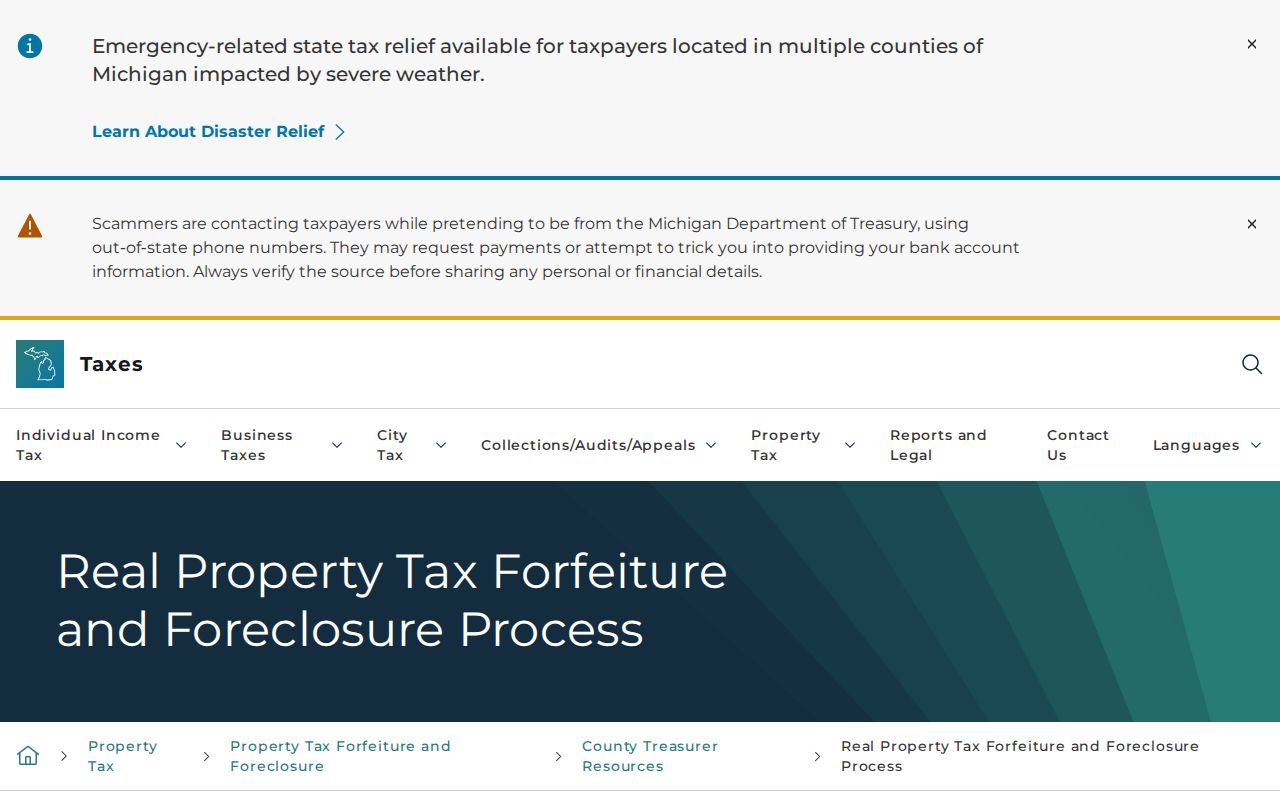
A Missaukee delinquent result fits somewhere along that statutory track. Only the Treasurer can confirm the live parcel status.
Look Up a Missaukee County Tax Bill
Start at the county-linked BS&A hub. Its service inventory lists address, name, and parcel-number searching, plus distinct current and delinquent tax routes. When a postal city, road spelling, or owner name creates ambiguity, the parcel number is the safest bridge.
- Normalize the address and find the candidate parcel.
- Confirm parcel number, municipality, and description.
- Open the current-tax service and record year, taxable value, millage, amount, and status.
- Check the delinquent service and Treasurer when an older balance or certification matters.
- Tax year
- The annual period to which values, levy, and bill apply.
- Tax lien
- A legal claim arising from unpaid property tax.
- Tax-current certification
- Treasurer evidence addressing status for the stated period.
The Missaukee Treasurer's Tax-History Record
The Treasurer page is more than a payment link. It serves as the county source for tax histories, certifications, delinquency, redemption, and tax-sale notices, and the official Treasurer page lays out those duties.
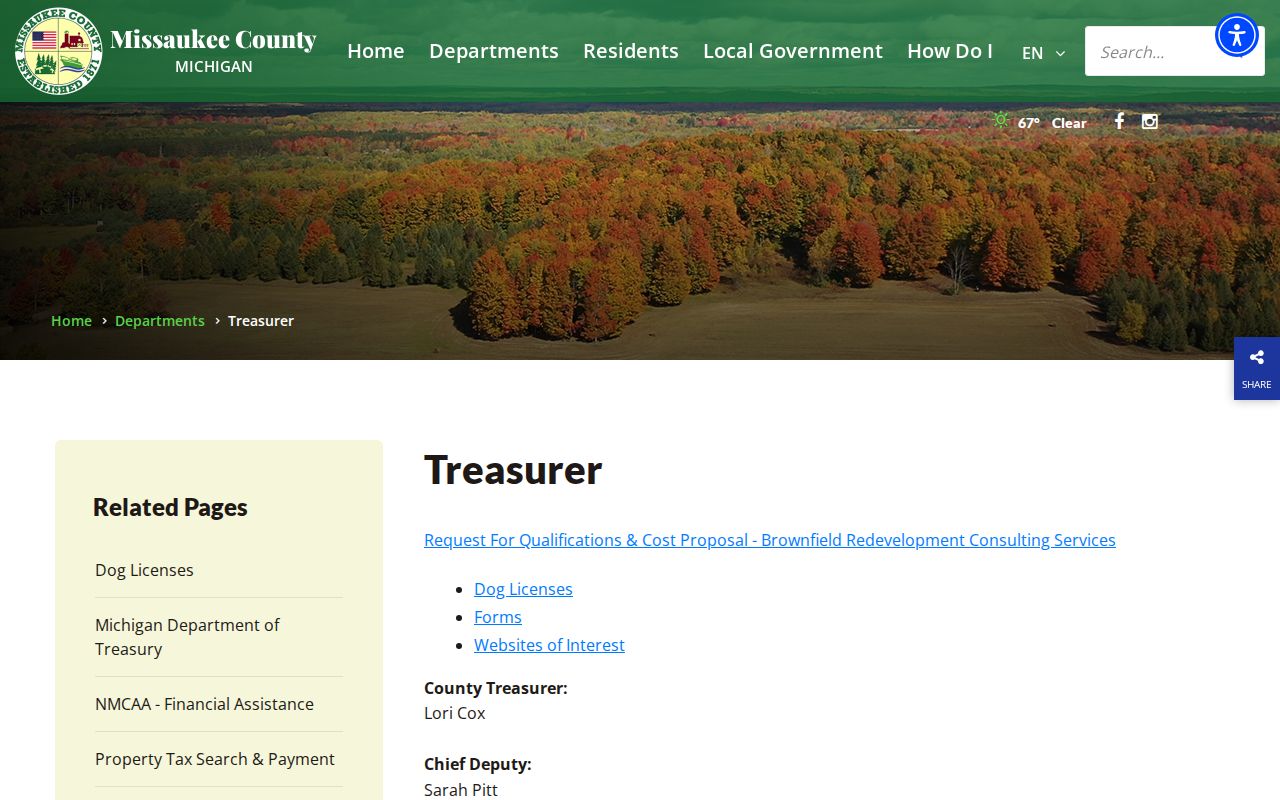
A look at the Treasurer's materials shows why any history or delinquency question belongs there, even when BS&A is the easier search entrance. Note: Ask for the exact parcel and year; a name-only request can mix separate tracts or similar owners.
PRE and Classification on a Missaukee Tax Record
The Principal Residence Exemption and the property classification both shape the tax picture. Neither is an estimate of price. Michigan Treasury publishes PRE requirements, affidavits, deadlines, and late-claim routes. Check the local assessment record for the status carried. Then ask the assessor about a correction or a claim. A transfer can change taxable-value treatment under Proposal A. Never infer a new taxable value from the prior bill alone. Keep the transfer date, assessment year, parcel code, and the exact figure in question.
Equalization and Local Assessors Split the Work
Missaukee County Equalization coordinates the assessment rolls. It publishes the property-information categories. It also provides the county BS&A link. For an individual assessment, classification, exemption, or Board of Review matter, the parcel's city or township assessor stays central. A Lake City postal address does not automatically make the City of Lake City the assessing unit. Likewise, a McBain mailing label does not settle whether the parcel sits inside McBain city. Route the question with the municipality field, parcel code, and taxing-unit information. Equalization works from the courthouse at 111 S. Canal Street in Lake City. When online access falls short, a focused phone call or letter should name the parcel. It should also name the municipality, tax year, field sought, and preferred copy format. Michigan FOIA remains an administrative fallback for existing records. It cannot force an office to calculate a new value or hand out legal advice.
Missaukee Tax Status Is Separate From Title
A paid tax record shows one thing only. It proves the tax bill was paid for the period listed. It does not prove the payer owns the parcel. A delinquent entry works the same way: it reports a tax condition. It is not a verdict on any person. To compare facts the right way, pull ownership from the Register of Deeds. Pull parcel identity from assessment and GIS records. Pull tax status from the Treasurer. Keeping those channels apart stops a payment name from being mistaken for the grantee on the latest deed.
For a purchase or sale, request current information close to the transaction date. Keep the response on file. For an inherited parcel, confirm that the assessment roll, probate transfer, deed, and tax account have each finished their own update steps. If a balance still shows after payment, hand the Treasurer the receipt, parcel number, payment date, and tax year. Never assume the web screen is the final word.
Search Fields That Keep Missaukee Tax Records Straight
The BS&A service hub offers three practical entry points: Address, Name, and Parcel Number. Address works when you know the situs. But spelling quirks, directionals, rural-route changes, and postal-city labels can return a wrong or missing candidate. Name searching helps when the assessed owner is known. Trusts, estates, business names, and shared surnames can still widen the results. Once confirmed, Parcel Number is the best cross-system key for keeping Missaukee tax records straight.
| Search field | Best use | Check before relying |
|---|---|---|
| Address | Find the starting parcel | Situs, road format, municipality |
| Name | Find parcels under an assessed owner | Entity and surname variants |
| Parcel Number | Move among assessing and tax services | Exact digits and taxing unit |
| Tax Year | Separate current and historic figures | Year shown on every result |
The detailed application is JavaScript-controlled, so fields can vary by result. Record only what appears on the live parcel. Then use the county's published category list to find which custodian can explain a missing field.
Tax-Current Proof for a Missaukee Purchase
A buyer reviewing a Missaukee County parcel often needs more than a portal status. The Treasurer maintains tax histories and issues tax-current certifications. Ask what period the certification covers. Provide the parcel number, and separate current taxes from delinquent taxes already moved into county administration. Save the issue date too, because a certification speaks only to a point in time.
Next, check the parcel number and legal-description clue against the newest deed. A tax-current document will not surface every title issue. A deed, in turn, proves nothing about whether taxes are paid. Building permits run through yet another channel at 113 E. Prospect Street, where the county requires the property ID for permit work. Use one verified parcel key across these offices. That keeps the due-diligence file coherent, without pretending any single record answers every question.
Contest a Missaukee County Property Assessment
Michigan's local route runs through the Board of Review, with further Tax Tribunal options depending on property type and procedure. Form 618 asks for county, city or township, year, parcel code, the protested value or classification, exemption status, and evidence. Check the current local notice for March Board dates. Do not carry an old calendar forward.
Appeal window. Dates and filing details vary by year and municipality. Confirm the live notice with the local assessor before the stated Board session or deadline.
Strong evidence identifies the exact parcel. It also isolates the exact issue. Useful items include relevant sales, an appraisal, condition documents, or proof of a classification or exemption error. Payment, redemption, and certification questions still belong with the Treasurer.
Keep the assessment notice and proof of timely delivery in the appeal file. A Board of Review protest must name the value, class, or exemption actually contested. A general complaint about the tax amount does not isolate the assessor's decision. Does the dispute concern millage instead? Route it to the office that controls that part of the record. The same applies to a payment posting.